Beyond Confinement: Art and Expression as Tools for Prison Transformation
Transcript of conversation with Jean Trounstine published 6 May 2026


Transcript prepared by JAS Virtual Services.
You can watch this conversation here or listen here.
Today we are joined by Jean Trounstine. Hi, Jean. Really glad to meet you today. Glad you could join us.
Jean Trounstine [00:00:30]:
Thank you. I’m really happy to be with you both.
David Jones [00:00:34]:
Jean, you’ve had a remarkable career as an academic teaching English literature at the Middlesex County College in Massachusetts. And of course, that’s only part of the story because you’ve also worked actively in supporting women in prison and you believe in the transformative power of literature. Can you tell us how you got into that path? What was it that interested you in that line?
Jean Trounstine [00:01:02]:
Okay, I’m going to try not to be as long as I possibly could be, David. But I will say that two things happened. One is that I had an epiphany when I saw a play in California done by a formerly incarcerated prison group. That was way before I started teaching at Middlesex Community College. But that stuck inside me because I had never seen or even considered the idea that people behind bars could take a piece of literature and turn it into a production. That’s one thing. The second thing is that when I was teaching at Middlesex, I was also actually taking a poetry class from a now friend of mine, wonderful woman, who was offered a job teaching at Framingham, and she couldn’t do it. She had too many things to do.
Jean Trounstine [00:02:03]:
And I thought this would be an incredible opportunity. It never occurred to me what it would be like to teach people behind bars. I hadn’t thought of people behind bars, but I thought this would be interesting. So actually I began teaching behind bars before I began directing plays of the women in one of my classes said to me, Jean, the men get to do theatre. Why don’t we? And that was putting those two things together, the impetus for me to start actually working with theatre behind bars.

David Jones [00:02:40]:
That’s very interesting. I think we’ve noticed this before, haven’t we, Naomi? How good ideas in one prison can be picked up by another one through interests, envy and emulation.
Naomi Murphy [00:02:52]:
But I was also reminded, Jean, of a conversation that we had with Baz Dreisinger. I don’t know if you know her, she works in New York State.
Jean Trounstine [00:03:03]:
Sorry, say the name again.
Naomi Murphy [00:03:07]:
So she’s a professor of English as well and done a lot of work with people who are incarcerated and she visited various prisons across the world. Kind of like looking at how different countries approach justice. So more of a sort of non fiction focus, perhaps. But it’s really interesting, I think, to see how the arts get into prisons and how it offers something nourishing to people inside.
Jean Trounstine [00:03:35]:
I think that so many things happen with prisons that are maybe serendipity or by happenstance, because prisons don’t really want education behind bars. It goes against the goals of the prison, which is to, in my mind, get people to be conformists in our society and follow laws, which is not a bad thing. But being conformists can have its drawbacks in other ways. And in terms of art, you really have to take risks to do creative things. And I think using the risk taker nature of somebody who might get in trouble with the law in a positive way is what I always felt was what I wanted to do.
David Jones [00:04:32]:
Thank you. Jean, you’ve already mentioned Framingham Prison. So I don’t know anything about Framingham Prison. Can you say a bit about it?
Jean Trounstine [00:04:44]:
Framingham is the women’s prison in Massachusetts. There really is only one in our state. And some states across the country have more than one, but most have only one because the number of women incarcerated is so small, even though they’re more harshly incarcerated in many ways than men. But Framingham is the women’s prison, and it’s really medium security, but it has many maximum security features, certainly not minimum. It doesn’t have that many women in it anymore compared to when I was teaching and working there, because I was there in the 1990s and it was a different situation. It would be almost unheard of to have a theatre program behind bars now. But then there were maybe 500 women incarcerated at Framingham for all different kinds of crimes. And as I say, I began teaching community college classes at the prison. So I was doing writing, I was doing literature before I actually began directing plays.
David Jones [00:06:01]:
So I didn’t quite understand, Jean, why do you think it would be unlikely to have a theatre activity there now. Is it just due to decline in numbers?
Jean Trounstine [00:06:12]:
No, I think that we have in our country a much harsher, much more punitive attitude toward people behind bars. Even more so than, I mean, it was pretty bad when I was there, but it’s worse now. And so the punitive nature doesn’t think people deserve to have programmes. One of the things that fascinated me when I went into prisons in England. I’ve been into prisons in different places around the world. Not as a researcher, but more as a practitioner doing programmes.
Jean Trounstine [00:06:47]:
And what I discovered is that other countries, England, I went in with this wonderful woman who I don’t know if you know her, her name will come to me in a minute. And I noticed that people in prison in England, some of the guys were getting guard help to apply to colleges outside the prison, which just blew my mind. You would never have that in this country. Such an adversarial relationship of guards to prisoners. The attitude here is that if you are incarcerated, you should be more punished because you’re incarcerated, not add to the punishment. So we have a very punitive attitude toward people behind bars in this country. And we don’t think of them as let’s get them better, healthier, smarter.
Jean Trounstine [00:07:47]:
So when they get out, they’re going to be better, healthier, smarter citizens. We think, you know, they did something wrong, let’s treat them as such. That’s what I say. It would be worse now.
David Jones [00:08:03]:
Right. I’m interested to hear about your experience in this country, which I suppose is probably a bit.
Jean Trounstine [00:08:10]:
Mary Stephenson. That’s her name, Mary Stephenson. It’s like I put it in a file drawer that wouldn’t come back, but here it is.
David Jones [00:08:18]:
Yeah. Well, that’s the kind of thing that happens to me all the time.
Jean Trounstine [00:08:22]:
I want to say that Mary Stephenson was an artist in residence in a prison in England. And that also blew my mind that there were artists in residence. You know, I had to scrape and, I mean, I can’t even tell you the things I went to to get theatre behind bars. And I directed eight plays. I really managed to stay there over a substantial period of time and not be ousted.
David Jones [00:08:52]:
What sort of plays were you creating?
Jean Trounstine [00:08:55]:
Well, I believe very strongly the first play I did was an adaptation of Merchant of Venice. I had come to England, I had seen Shakespeare doing Merchant of Venice. I had gotten a grant to, my idea of fun is to go to 23 plays in six weeks. And I did so in Stratford and in London. And I saw a very wonderful production of Merchant of Venice. But it wasn’t my idea of Merchant of Venice. So when I got back to the States, I had gotten this grant to direct a play in prison.
Jean Trounstine [00:09:29]:
And I decided to do Merchant. And it was really interesting because the women were like, are you kidding? And I said, if you can understand Shakespeare, if Shakespeare becomes accessible to you, you can understand many other things in life. And that was always my attitude, to make something accessible. And so I did class classic texts. And when I say classic, I mean Shakespeare, Lysistrata. You know, from the Greeks, Madwoman of Chaillot. I did an adaptation of the Scarlet Letter by Nathaniel Hawthorne. I really believe that the classics were things that the women that I taught didn’t have access to and should have access to, just like the rest of us.
Jean Trounstine [00:10:18]:
So that’s why I did those plays. I mean, many other people were creating theatre from text, but no one, I mean, I was the first person to direct a Shakespeare play in prison worldwide. I don’t know if you know that, but I didn’t know it till this year because I didn’t think about it. I didn’t think, oh, I’m directing a play. You know, I thought, I’m just doing some work here. And many people in England had done Shakespeare, but there was not a directorial experience before mine. So fantastic.
Jean Trounstine [00:10:54]:
It was very interesting to do Shakespeare with the women because they loved the stories and they ended up adapting the text and they would use pieces of Shakespeare and the same with other texts. They would use pieces of the language and adapt to their own circumstances. And that became our method of working.
Naomi Murphy [00:11:16]:
I was just looking up because I was trying to remember we had somebody on who was doing Shakespeare in a prison. Her name was Rowan Mackenzie. Her name had escaped me in the same way that that had. But again, I think it’s important that we don’t dumb down for people in prison, you know, and so exposing people to the classics. We’ve also had somebody on talking about teaching philosophy in prisons as well, for instance. And I think, giving people access to parts of what is part of our ordinary cultural heritage that people should have access to feels really important. So it’s really brilliant to hear about the kind of work that you’ve been doing Jean.
Jean Trounstine [00:11:55]:
Thank you. It was interesting because I did not start writing until I, really writing I mean, I had written a lot of things, but I didn’t really start writing a book until I started working at Framingham. Because I was so alone at that period of time in my life. I didn’t have people to talk to. There weren’t other people doing this work then. I was really a pioneer. Curt Tofteland, who has a wonderful programme, you might have heard of him, he has a Shakespeare Behind Bars programme.
Jean Trounstine [00:12:27]:
He started it also, but with men. And now there are many people doing theatre in prisons across the world. And many, you know, there’s a theatre in Shakespeare, there’s Shakespeare in prison and theatre in prison and so much. But I was alone. And that’s what drove me to write and to tell the story of the women in my first book, Shakespeare Behind Bars: The Power of Drama in a Women’s Prison was written because of that isolation I had. And so here I am, eight books later, talking to you. But I had no recourse, really, except to go to the page. There was no Internet. We didn’t know who was doing anything anywhere else.
David Jones [00:13:15]:
Yeah, you’ve written some terrific books. I haven’t read them all, but I’m thinking of one I was looking through earlier today about the experience of parents of mothers when their children have committed crimes, which, of course, is an extremely powerful area to be writing about.
Jean Trounstine [00:13:39]:
Yeah, Mother Love was my first fiction. And now I’ll just make a little plug for my new book out on 12th May, Sounds Like Trouble to Me, but my first book really was a memoir, even though I didn’t know that it was a memoir because I wrote about the women, not about myself, but it was from my point of view. I mean, I don’t think we had the word creative nonfiction too much in our vocabulary then, but that’s what that book was. But Mother Love was my first fiction, and it was a book of short stories. And that’s what kind of got me to do Sounds Like Trouble to Me. I had not considered fiction.
Jean Trounstine [00:14:22]:
I’ve always been a nonfiction. I thought of myself as a nonfiction writer.
David Jones [00:14:27]:
Right. So that was the genesis of Sounds Like Trouble to Me. So was it your experience at Framingham prison that led you to write your latest book?
Jean Trounstine [00:14:44]:
Well, I want to say that the genesis was becoming knowledgeable about women in prison, first of all. And that happened over a long period of time. And I talked, read, listened, learned from the women I talked to. But then I also did a lot of exploration on my own that got me into understanding women, research, going to places like I went to a conference with Angela Davis in Australia on women in prison. I went around this country talking about women in prison, learning about women in prison. And then I got to know a lot of women.
Jean Trounstine [00:15:32]:
And that led me for many years writing about them. And I’d say that I couldn’t have written a novel if I hadn’t spent 30 years really understanding the criminal legal system and knowing people I never would have. I mean, the novel came out of two true stories. One is a correction officer. A real correction officer. Well, she was a warden in this country who killed her abusive husband and had to go, was sent to the awaiting trial unit. And I thought, wow, what it would be like for someone who was on one side of the law to then be on the other side of the law. That was one story and then the other story.
Jean Trounstine [00:16:13]:
And I don’t know if you’ve heard of this one, but it might have happened in other countries and other places not quite so prevalent as in our country, I think, because of the amount of abuse. But a very important uprising took place at a federal prison in Dublin, California, where the women, 300 women, filed complaints against the people in power. And it included a chaplain, the warden of the prison, and many, many correction officers. Because of the sexual and verbal and physical abuse of the women. That story inspired me also. And so in my fictional prison, the women, the correction officer, without giving away too much, becomes an instigator, eventually gets to be friends. Very unusual, but gets to be friends with the women behind bar, some of them. And because of her own experience with abuse, understands other people’s experience with abuse.
Jean Trounstine [00:17:16]:
And they create a MeToo movement behind bars. And that could never have happened without my knowing, without my, I talked to one woman every Sunday night who helped remind me of the smells and sounds of Framingham. So I could use them in my fictional prison, which takes place in Massachusetts. But without that, I wouldn’t have been able to, I don’t know, create fiction. It wasn’t on my agenda, fiction, but it works.
Jean Trounstine [00:17:51]:
And it turns out to be, in a funny way, more truthful than truth.
Naomi Murphy [00:17:57]:
Yes, I think we interviewed the journalist who covered that story, actually. Cause we saw it in an American media, didn’t we, David? Again, my memory.
Jean Trounstine [00:18:11]:
Oh, I’m so happy it happens to someone else, Naomi. So that’s great. I’m glad to hear that.
David Jones [00:18:21]:
That wasn’t Eyal Press say, was it? I don’t know if you come across Eyal Press. He writes for the New York Times, and he’d written a book called Dirty Work, which included the last chapter on work in prisons, which came across as being extremely challenging. So in your book, the kind of main character is Nettie, and she’s quite a complex character. So I think you mentioned that you identified with one of the women that you’d met in Framingham. How did you develop her personality and the story around her?
Jean Trounstine [00:19:15]:
Nettie’s story?
David Jones [00:19:17]:
Yeah.
Jean Trounstine [00:19:18]:
Well, Nettie, again, Nettie was based on the warden, who I didn’t know, who killed her abusive husband and went to a waiting trial unit. I couldn’t find any information about that warden. I didn’t know if she actually got sentenced. Because in our country, I need to say awaiting trial is a different kind of restriction than being sentenced. However, it can happen in the same prison. You could be in the awaiting trial unit at Framingham, in the real Framingham, and not be sentenced. So I created a fictional prison, the Merrimack Correctional Institute, I call, where there was an awaiting trial unit. And my officer went there.
Jean Trounstine [00:20:08]:
She was a correction officer, not a warden. Now, she was not based on any one character. She was based on a sort of an amalgam of my understanding and knowledge of correction officers and my understanding and knowledge of women and the kind. I mean, I work in many programmes with people who are probation officers, correction officers, and I feel like I know some of that mentality. I also have seen them change to have some different sympathies toward the people who are sentenced. So that kind of came into where I got Nettie. Nettie also has some of me in her, I would say, some of what I imagine I would feel like if I were sentenced and went behind bars. How could that not be? Because I have never exactly experienced that.
Jean Trounstine [00:21:10]:
But Nettie is the person who thinks she never will go to prison and will be a guard and will be representing that point of view. And that is a hard point of view to change in some cases. So I had to work very hard to create other people behind bars. And how I found them, I would say, was very much based on the women I knew at Framingham, women I’d seen in programmes around, and people and things I made up.
David Jones [00:21:47]:
Thank you. So that sounds like quite a complicated task for a first novel.
Jean Trounstine [00:21:53]:
It was really complicated because I think Joan Didion said it really the best. She said, I write, and I’m going to paraphrase her here, because I’m not going to get it right. I write to entirely find out what I’m thinking. And that is how I had no knowing. I didn’t know where I was going. I wrote and something would happen. Like, I wrote the first lines of the book, which are.
Jean Trounstine [00:22:26]:
And I can tell you that Nettie was just as still as her husband. The difference was she had a gun in her hand. And I thought, oh, okay, and how did she get the gun? Oh, okay, what is she doing with the gun? So that is how my mind worked. And some novelists, of course, would know where the gun is, how it happened. But this was my first book. So I think as a writer, it wasn’t my first book. It was my first novel.
Jean Trounstine [00:23:01]:
It was my eighth book. And I trusted myself. I trust myself enough to go where I needed to go. And so the fact that I created her lawyer as an African American woman, the fact that I create her best friend in prison as part Native American, Molly, you know, those things happened not because I thought, oh, let’s do that. And I do think it’s layered. The book is layered. I mean, I don’t want to pretend that I didn’t have help.
Jean Trounstine [00:23:33]:
I hired people to help me rewrite in the sense of developmental novel people. But I had to write without knowing where I was going, if that makes sense to the two of you.
David Jones [00:23:50]:
Yes. So the book was a voyage of discovery for you as well. Very interesting. What message do you hope readers take away?
Jean Trounstine [00:24:03]:
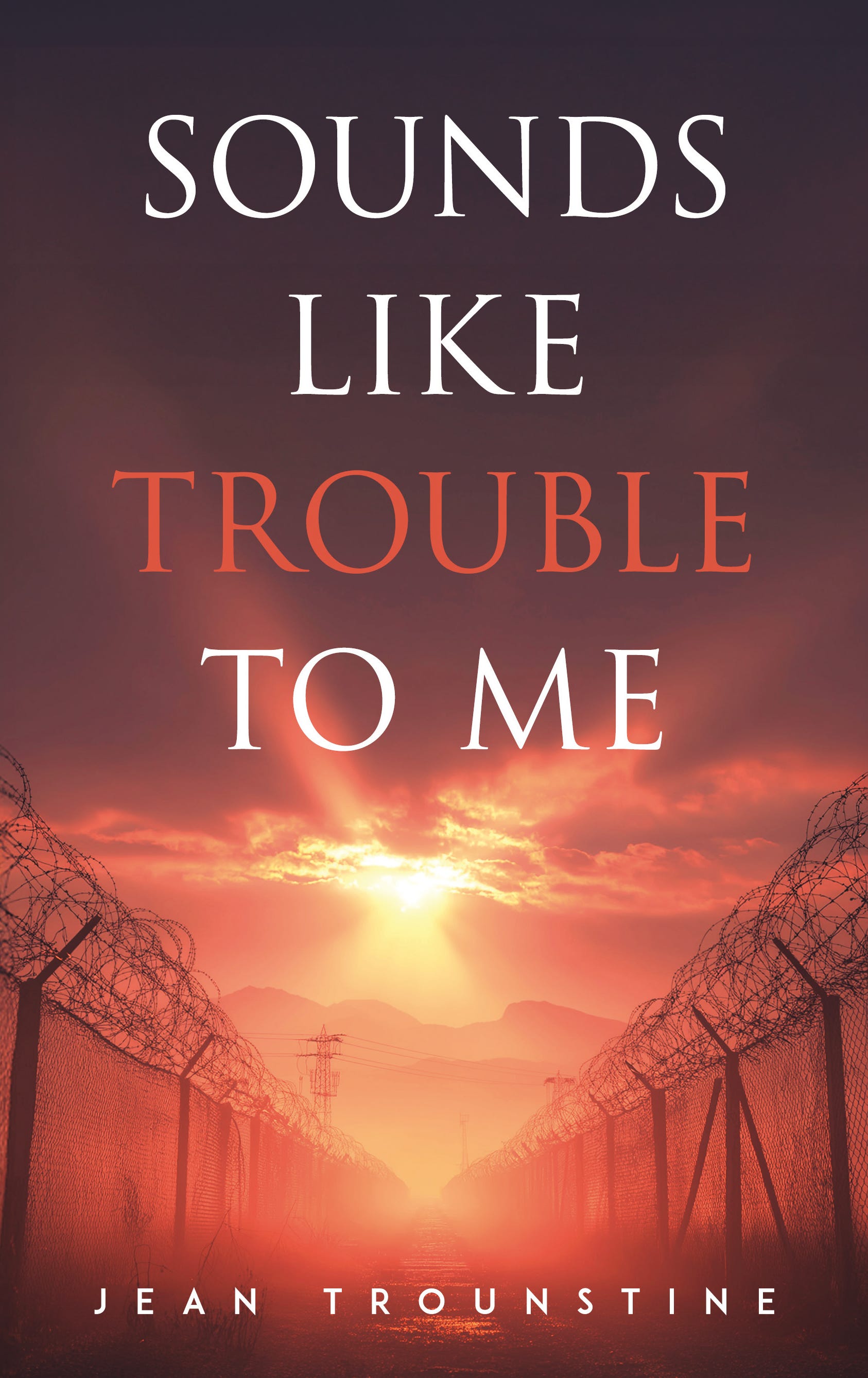
I wish my book had the cover correct so you could see this. But I want to say one thing I love about this. You can see this, and it relates to what you just said. There’s light here. There’s a sense of people being confined. And here is the wire, people being confined. And there is, of course, the word trouble, which is in red. Sounds Like Trouble to Me.
Jean Trounstine [00:24:31]:
So the trouble, it has two meanings. As John Lewis said, good trouble. We have good trouble. We have awful trouble, and we have light. And I think what I hope is for people to see many things, that prison is a place of horror, trouble, darkness. Darkness, you know, darkness around it. And yet the community of women that conform in prison, the community behind bars, brings an incredible grace and an incredible hope, and that people don’t realise how powerful women behind bars can be when they speak out. Of course, there are repercussions, and the Dublin women would tell you that every second of the way.

Jean Trounstine [00:25:19]:
Of course there are repercussions, but is it worth it? The Dublin women close the prison now, they got transferred all over the country in the United States, but they closed that facility and they took people to trial. And there is power in this. I want people to understand that. I also want them to understand that abuse, which we now have so prevalent in our Jeffrey Epstein era, happens behind bars. I don’t think people in the world think about that, what it would be like to have an abuse situation in another. I mean, where you’re already held and kept and silenced and then to be abused.
David Jones [00:26:11]:
Thank you.
Jean Trounstine [00:26:11]:
I want those messages to get out.
Naomi Murphy [00:26:15]:
So, Jean, you’re obviously touching on very sensitive issues like domestic violence and trauma, sexual abuse within your novel. How do you approach writing about such sensitive topics and getting the balance right about the amount of detail? How do you cover these stories as an author in a way that delivers a message but is sensitive enough to the, you know, to stop people switching off. Because that can be one of the problems with darker material, can’t it? That people don’t want to listen. So how do you balance that?
Jean Trounstine [00:26:47]:
Well, I think the first thing is you don’t think about the message. You think about the development of the characters. Now, because I am me, and what is in my mind is in my mind, I think that plays into who the characters are and what they become. But it wasn’t like I thought, oh, I want. I mean, okay, I’ll be honest. There were moments when I might have thought, I think it’s very important for the lawyer who is a black woman and the person who’s the main person in prison is a white woman, that there is a power dynamic that we often don’t see switched. I think, of course, there are millions of black lawyers who are incredibly powerful, and my character Isabel is modelled on them.
Jean Trounstine [00:27:35]:
But that is a message to some degree. And I do think, in some cases, yes, I had some of that in my head. But most of the time, honestly, the message came out of the writing. The message came out of the character creation. And then I would say, yes, that’s right. Let’s shape that. What am I saying about Damasce? I mean, it would delight me when I found one of my characters did something that was the right thing for her to do. But it wasn’t like I said, oh, she has to do that.
Jean Trounstine [00:28:14]:
It was more like I discovered her doing that, and I was happy she was doing it. So that’s one answer to your question. The other thing is, I did enormous amount of research, just literally on the side. And I think this is what happens with many writers, novelists. You do your research. You do. Like I talk to people who were forensic psychologists about memory. I did work on memory.
Jean Trounstine [00:28:43]:
I had to think about memory. I couldn’t just have, my main character forgets a lot of what happened to her, which is about trauma, is what happens with trauma. I know women, many women who’ve had trauma. I’ve had some trauma. I don’t think that we kind of get through this life without trauma. What do we remember? What do we forget? So I did a lot of research on trauma, on memory, on domestic violence. And then I had my characters just be.
Jean Trounstine [00:29:19]:
So those two things kind of came together, if that makes sense to you.
Naomi Murphy [00:29:23]:
Yeah, it was interesting as you were talking, actually, it reminded me. I’ve watched Madonna being interviewed by Jay Shetty just last year, and she was talking about how her music just kind of like flows, almost like, she’s just a conduit for that to happen with her music. And in a way, that sounds like that’s what’s happening to you with your story, that the story’s flowing almost like you don’t know where it’s going next, but you’re just allowing this story to be delivered. But I was interested in what you hoped your readers would learn about the issues that are covered in the book, including themes like abuse and corruption. What do you hope your readers will learn, and what action do you think? What are you hoping they’ll do about it?
Jean Trounstine [00:30:07]:
Well, I’ve written enough books that I can’t honestly say that too many people take action after reading books. I think maybe with nonfiction, that can happen somewhat. I don’t think that’s what’s in my mind action per se, but understanding is in my mind. I do want people to see, to have a broader view about women in prison, that they really are just people that are many cases poor, have terrible circumstances, are in situations like Nettie even, who is a very normal, average person, except what happened to her in her past wasn’t normal and average. And so she gets subject to an abusive relationship. I mean, it takes a woman, I’ve learned, over seven years to get out of an abusive relationship in a domestic violence situation. And I’ve learned a lot about domestic violence.
Jean Trounstine [00:31:17]:
And I want other people to understand more about women behind bars than they do now. And really, that translates into people behind bars, because men also deserve some consideration. No offense. It’s a little different. Women are, I think we romanticise men behind bars to some degree, and we sort of throw away women behind bars. I’ve often thought about that, that women are thought of as, and it’s not in our consciousness, it’s in our subconsciousness culturally. We dismiss women as prostitutes or whores or they’re trashy if they go to prison. I used to ask my students, would you go out with a woman who was sentenced to prison? And they were like, nah. But a woman, would you go out with a guy who was sentenced to prison? You know, there’s this sort of romantic, dangerous guy thing of trouble, sort of appealing to a certain kind of female sensibility. And I think culturally that stands. If you see movies, men are romanticised that get in trouble with the law. Women are not. There is nothing romantic.
Jean Trounstine [00:32:39]:
So I think we have to get rid of some of those stereotypes, those cultural myths. And one of the big myths is about women being worthless. I mean, many women who go to prison do have low self esteem. That’s a true truism because they’ve been treated so harshly and abusively. But their self esteem can be heightened, too. They don’t have to live like that forever.
Naomi Murphy [00:33:15]:
So it sounds like your book’s a bit of a plea for a more compassionate outlook on those behind bars.
Jean Trounstine [00:33:23]:
I think that’s true.
Naomi Murphy [00:33:36]:
Your novel touches on the MeToo movement and its impact on incarcerated women. Why was it important for you to include that theme?
Jean Trounstine [00:33:47]:
Well, again, it didn’t become important until it became important until the women had. The reality of women behind bars is that they are abused. That is the reality. Even though one group of women rose up at Dublin, that doesn’t mean there aren’t women across the country. And I read about a group recently in a Texas prison that also spoke out. I mean, it’s incredibly hard to speak out about this. So I never really thought of MeToo until it became a big story in the press. So I realised that that abuse that is happening in the world is really not that different than the abuse that is happening behind bars.
Jean Trounstine [00:34:43]:
It was more my realisation that led to making it important than that I wanted to make it important just because I realised that women have been going through this who have been sentenced to, I mean, they certainly were, when I was teaching at Framingham, it might not have been as open or spoken of, but there were always women I heard about who were ambushed by somebody in a broom closet. You know, it was a secret. That was not a secret.
Naomi Murphy [00:35:20]:
Thank you. And, Jean, how do you ensure the authenticity of the legal and prison related details in the book?
Jean Trounstine [00:35:27]:
That’s a really good question. I’m so glad you asked that, because no one has asked me that yet for any book I write. And I did this with nonfiction and with Mother Love. I did it with Mother Love, and I did it with Sounds Like Trouble to Me. I have a friend in some cases, I’ve hired him to go through the book legally and chapter by chapter and correct things, help me figure out things, all of that. So the book was vetted by a lawyer, by an attorney, very carefully. Now, he might have made some mistakes, too.
Jean Trounstine [00:36:08]:
I don’t want to pretend that I’m perfect. And that I won’t have some mistakes. I read other novels, and I have to be honest, I go like, oh, my God, how can you put that in the book? Oh, my God, that’s so terrible. And I try really hard not to do that. But I’m sure there’ll be some attorneys that read my book and say, Jean, you didn’t get this right. I did have one person that read one of the stories in Mother Love, a judge who contacted me and said, I think you did a fabulous job on the book, legally, but no, this one thing, he should have been in prison for life.
Jean Trounstine [00:36:41]:
He never would have gotten out. And I said, okay, okay, Jay. You know, so there may be some things like that, but I’m hoping that I got enough close to the bone that it’s not going to be a problem. It was hard in terms of the trial, because there is a trial, and really getting a trial right is a big deal. So that took a lot of work, and I had to study a lot of trials, and I did. I mean, I’ve read trial transcripts, which really helped me. And trial transcripts are fun to read. They’re very dramatic, from my point of view, much more dramatic than people think.
Jean Trounstine [00:37:23]:
They’re kind of exciting. Even though the lawyers are not trying to make them dramatic. They are.
Naomi Murphy [00:37:30]:
It’s interesting that you go to so much length to ensure the sort of integrity of what’s happening in the book, because it is quite irritating. I think, as a forensic specialist, when you see things happening, you just think, you roll your eyes because you think that wouldn’t happen in real life.
Jean Trounstine [00:37:46]:
So, Naomi, is that something I can guarantee that you’ll help me with when you’re going to tell me if there’s anything wrong with my book?
David Jones [00:37:54]:
She’s a great expert.
Naomi Murphy [00:38:02]:
So, what role does friendship and solidarity among the women play in your story?
Jean Trounstine [00:38:08]:
Well, I’ve touched on that a little bit, but I’ll add to it, which is two things. One is I try to get across the barbs and arrows that women sling at each other. I try to get across both the antagonism. I mean, one of the things just to go sideways a little bit on something that happened when I was at Framingham, that always affected me. One of the women at Framingham, I used to say, you know, men stab each other when they’re mad at each other. They get a knife, they stab, you know, directly. You know, that kind of thing. Women.
Jean Trounstine [00:38:48]:
One of the women at Framingham took another. They were allowed perfume at that time, if you can believe it. But this woman took another person’s perfume bottle and peed in it. And that is the kind of violence that I saw that women sort of beget against other women. So I wanted to be truthful that there can be a real, a real anger, jealousy, hatred. There is that, you know, women can be hostile and horrible. And yet on the other side of that is a kind of bond that doesn’t happen with men. A bond of telling each other their secrets, crying with each other.
Jean Trounstine [00:39:43]:
It takes time. It doesn’t happen. I mean, the level of trust is horrible at first. But I’ve learned from some of the people that I know outside of prison how much people connect. One of the women who I taught in prison is now outside and she, her name is Angie Jefferson and she’s coming with me to my debut at Porter Square Books on the 13th of May, she will be there with me. She was a student of mine at Framingham and now she’s there to be able to talk about Sounds Like Trouble to Me with me.
Jean Trounstine [00:40:22]:
Which is amazing because she has the experience of understanding what went on behind bars. And another woman who I talked to every week was in prison at Framingham and created community with women and vowed when she got out of prison to start a re entry programme, which she has done. But it began because she had connections with the women behind bars. So I think the connection of women is both soulful and spirited and filled with what we have in the outside world, but even more so because they are locked up and the attempt is to silence them.
David Jones [00:41:12]:
Thank you, Jean. I don’t like the word activist, so I’m not going to describe you as an activist because certainly in this country that word has been co opted by the right wing and given the kind of disparaging flavour, as in activist lawyers implies that people are perverting the course of justice. But I think it’s true to say that you’ve been an active campaigner for much of your life. What is it that’s particularly attracted you to prisons and the justice system?
Jean Trounstine [00:41:50]:
Okay, well, I know it’s very British not to cry, so I’m definitely not going to cry when I tell you this, but I could cry because it’s very moving to me. I think my experience teaching behind bars changed me, just changed me, made me understand what women go through who are locked up. I didn’t know one small story. I am a storyteller, after all, so I relate with stories. When my mother died and I was teaching. I had to go do my class behind bars. It was within a couple of weeks after my mother had died and I went into prison. And I was directing Merchant at that time and working on Merchant, and we were going to do something.
Jean Trounstine [00:42:51]:
I can’t remember exactly what I had planned for that evening, but I got into the room and I told them, you know, not really with emotion or anything, but I felt like I needed to tell them why I had missed a class or something. And I told them. And they immediately formed a circle around me and began doing, you know, some sort of comforting motions and sounds and talking to me and something like out of the creative things that I had taught them, but about me, as if it was a funeral for my mother. And I was. I wept and I was touched. And I hugged them all. You’re not allowed to hug people in prison. And I hugged each one of them.
Jean Trounstine [00:43:53]:
I mean, we were in a room, nobody was observing us. And for a moment, we had that privacy. And for a moment, we were just women together. It changed me.
Naomi Murphy [00:44:14]:
You can hear you’re really moved as you share that anecdote, Jean. And I’m reminded also of something you said earlier on in the conversation, which was about risk taking and how you were kind of doing a more positive perspective on risk taking, you know, looking at risk taking from more positive perspective, which I think one of the themes that have come across many times on this podcast has been the importance of belief, you know, the importance of seeing the human in somebody rather than seeing them just as the worst thing that they’ve ever done. And, you know, it’s quite clear that you were able to give them that gift. But equally, there’s a reciprocity in that relationship, isn’t there, that actually you see the human rather than see each other as foes or person of power and person of no power.
Jean Trounstine [00:45:09]:
Well, you know, I’ve been a risk taker. I was a risk taker. I was lucky. I was a product of the 60s, a hippie. I lived in California. I lived in a commune. I did all sorts of crazy things that I’m glad I did them in my youth.
Jean Trounstine [00:45:27]:
But I wasn’t poor to the degree that these women are poor. I wasn’t black. I had always had educational opportunities. I always had parents who somehow were there for me, were always there for me, even through my hippie crazy days. And it’s not like they abandoned me. I had financial security. If something horrible had happened to me, I could have gone to live at home.
Jean Trounstine [00:45:57]:
I didn’t have what so many people have who go to prison do. So I think that risk taking. I don’t think that people take risk necessarily when they start out. I’m not speaking of myself. I’m speaking of people who commit crimes. I think they may take risks because they are desperate. They take risks because they don’t have choices, because they’re stealing for their child.
Jean Trounstine [00:46:29]:
You know, they’re living in a situation, some guy is abusing them and they have to be a drug mule or they’re going to be more abused or, you know, terrible things can happen. But the taking risk in a theatre production becomes an enlightening way for people to see that there is a risk. They’ve developed something in their personality from this life that is all of a sudden, an amazing payoff. They are brilliant on the stage, they are creative, they are good. There are other women behind bars say, oh, my God, you changed my life. This one woman, Dolly and who played Bassanio in Merchant, said, I was a star for a week, I was a star. And so, yes, the community becomes fulfilling for them and therefore for the teacher.
David Jones [00:47:45]:
Thank you. Those are very powerful accounts there. Jean, now that you’ve been describing things which I’m sure Naomi and I both recognise that some of the transformational incidents in the lives of the people we’ve been working with are those kinds of humans contacts, which may not last very long or they may be quite extensive. But an example is often given for the men who go to a prison, I worked at Grendon, is that when they arrived, the officer approached them and said, hello, you must be Ray, my name’s Bill. And just that is so different from their previous experience that it makes a difference.
Jean Trounstine [00:48:40]:
So I want to say I have had some experience working with men since you brought up men, but not with theatre. I have had experience with this other programme I do, Changing Lives Through Literature, which I think it’s worth talking about a bit because I think it’s right up your alleys. So Changing Lives Through Literature. I got into that when I was teaching in prison, inside prison. I’d heard about a judge and a professor who had, well, the professor, this is a very boys clubby kind of thing that I thought was funny, but now I think it’s a good story.
Jean Trounstine [00:49:29]:
The professor said to the judge, I think I can do better than you do, keeping out of prison, having people read books. He said to the judge, you don’t do a very good job of keeping people from recidivating, and they go back to crime. But I think I could do better with literature. And so they started this at the time. It always seems to have a very grandiose title, Changing Lives Through Literature. But it makes sense in a way. They started, they got eight, I think 12 guys at the time with terrible quote rap sheets.
Jean Trounstine [00:50:02]:
They all had done awful things, but they were out of prison, they were on probation. In this country, on probation means a little different perhaps than in other countries, which is you usually have not yet gone to prison, although sometimes you have and have been out. Mostly when you’ve been to prison and you get out, it’s parole. When you’re out in the community with a chance of serving the rest of your sentence in the community under very strict supervision, that’s parole. If you’ve earned that. If you get out, it’s not a free pass or anything, but you get some time outside. Probation is something you get sort of before you go to prison, often where you get it because the judge says, or a probation officer says, let’s give you a chance to do these things right before we give you a prison sentence, seeing if you could do this and that, get drug tested, blah, blah, blah, stay out of trouble, stop doing drugs, stop dealing drugs, whatever the issue is. So they took people on probation, and the idea was they would meet every two weeks, read a book and talk about the books.
Jean Trounstine [00:51:21]:
And the professor chose the books. And after they got done with the programme, at some point, they did some recidivism and discovered that with this group meeting over a period of time, yes, indeed, they had stayed out of crime more or less more often than the other group. And I heard about this with men, and I said, wow, I have to do this. But at the time, it was with women. And I did it, and I have done it since 1993 with women. And then at one point, I’ve also started doing it with men. And I do it now with men on probation. I did it with actually men in prison.
Jean Trounstine [00:52:13]:
And I have a programme, the Changing Lives Through Leadership programme. We have about maybe 20 programmes in different courts throughout the state. The people meet outside, they meet at colleges or universities. The people go on campus. We read books, we quote, discuss. Here’s the phenomenal thing. So in this group, a judge, a probation officer, a professor, and a group of people who are on probation and all ideas are equal, no idea is more important than the next. And I’m sure you understand this.
Jean Trounstine [00:52:55]:
I’m sure you’ve heard about things like this. But Changing Lives Through Literature is a Massachusetts programme, basically. And we used to be all over the country, but we’ve really sort of honed in on Massachusetts now because we’re through the trial court in Massachusetts, and we have people are paid and the professors are paid, and we have phenomenal, interesting conversations in a, quote, Democratic reading group. So I wanted to tell you about that.
Naomi Murphy [00:53:28]:
I’m really glad you did. What a lovely initiative. Really, really lovely to hear about that. So, Jean, we’re coming to the end of Time, and I wondered, what’s next for you as an author? Are you working on another book or another project?
Jean Trounstine [00:53:42]:
Well, it’s very hard for me to work on another book while I have a book coming out, like, right in the middle of this. I think some of my friends are much better at that than I am. What I am doing right now is I’m writing small pieces, trying to get them published in things like. Well, for example, I wrote a piece on why fiction versus nonfiction, something like that, and getting those kinds of pieces published because I have so much to say on this subject, and I have things and I can get them published. And it’s so interesting to be having a novel versus having been a nonfiction writer. So I have those kinds of things to say. I’m hoping maybe I’ll gather them into a book, but not for sure. I have an idea of something I want to write, but I never want to talk about it before I do.
Jean Trounstine [00:54:44]:
I hate to even say the word. It does have some fiction to it, though, but I don’t know. We’ll see. It has to always be based on a true story, and this one is.
Naomi Murphy [00:54:58]:
Thank you. It’s been really great to talk to you today, Jean, and hear about your experiences. Fantastic. Thank you.
Jean Trounstine [00:55:04]:
Thank you so much for being interested, and I appreciate it enormously.